What Type of Air Conditioner Should I Get?
What Type of Air Conditioner Should I Get? (A Straight-Talking Guide for Springfield Homeowners)
If you've started looking into air conditioning, you've probably already noticed there are a lot of options — and a lot of conflicting advice online. Window units, portable AC, ducted systems, split systems… it can feel overwhelming pretty quickly.
Here's the honest version, from someone who installs these things every week.
The Main Types of Air Conditioners
1. Window Units
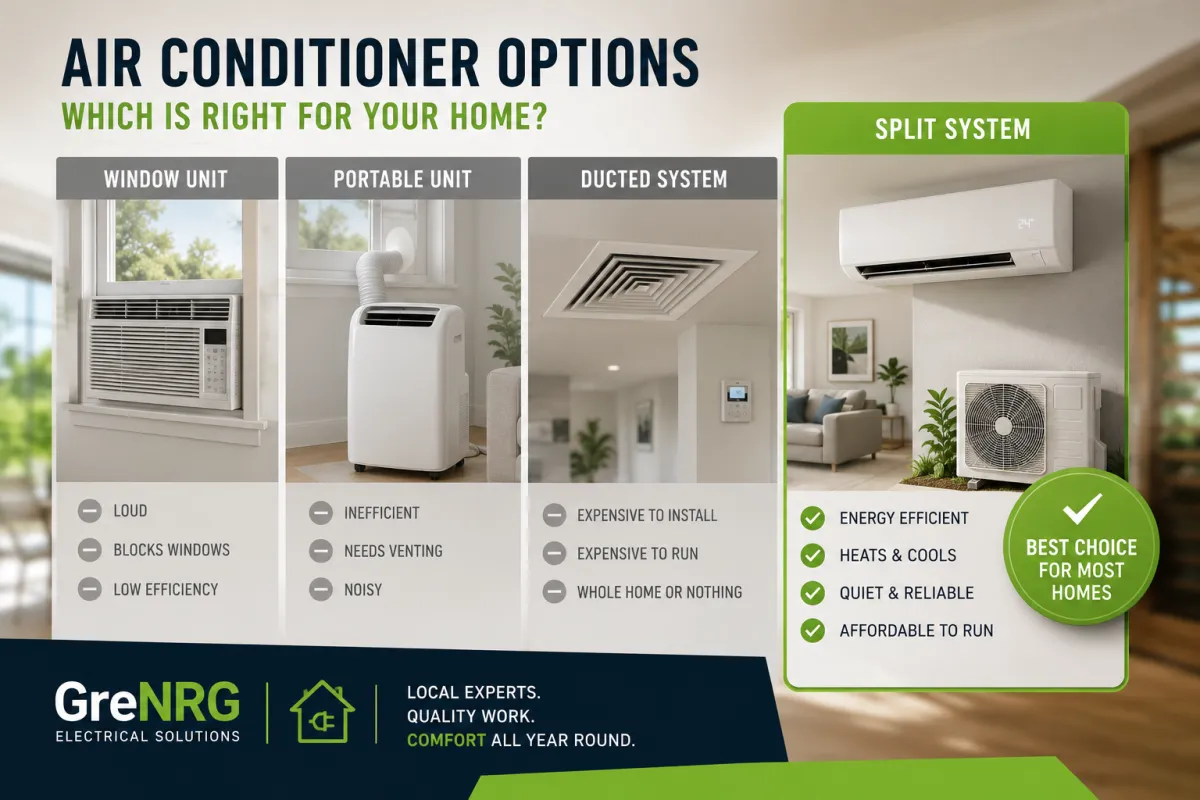
Window air conditioners sit in — you guessed it — a window frame. They were popular in the 80s and 90s and you'll still see them in older rentals. They're cheap to buy, but they're loud, they block natural light, they're not energy efficient, and most modern homes in Greater Springfield aren't designed to accommodate them well.
Unless you're cooling a single room in a rental where you can't touch the walls, there's almost no reason to go this route in 2026.
2. Portable Air Conditioners
Portable units look convenient on paper — no installation, just wheel it in and plug it in. But here's what the box doesn't tell you: they need to vent hot air somewhere, which means a hose going out a window or door, which means you're leaving a gap to the outside. They're also notoriously inefficient and surprisingly loud.
They can work as a short-term fix, but they're not a real solution for Queensland summers.
3. Ducted Air Conditioning
Ducted systems are the premium option. One central unit conditions your entire home through a network of ducts in the ceiling, with vents in each room. It's discreet, it's powerful, and it looks great, but it's expensive to install (we're talking $10,000 to $20,000+ depending on the home) and expensive to run if you're cooling rooms you're not using. Also, remember if you have a fault, the whole house goes without air conditioning
Ducted makes sense in large homes where you genuinely need whole-home cooling, and you have the budget for it. For most homeowners in Greater Springfield, it's more system than they need.
4. Split System Air Conditioners
This is the one we recommend for the vast majority of homes, and here's why.
Why a Split System Is (Almost Always) the Right Choice
A split system has two parts: a sleek indoor unit mounted on the wall, and a compact outdoor unit. They're connected by refrigerant piping and a small amount of electrical cabling. That's it.
They're energy efficient. Modern split systems — especially inverter models — use significantly less power than older technology. They ramp up and down based on what's actually needed, rather than running flat-out the whole time. This makes a real difference on your power bill, especially if you're also running solar.
They heat and cool. A good split system is a reverse-cycle unit, which means it works as a heater in winter too. You get year-round comfort from one appliance.
They're affordable to install and run. Compared to ducted, the upfront cost is much lower, and because you're only cooling the rooms you're actually in, your running costs stay manageable.
They work well with solar. If you've got solar panels on your roof, a split system lets you time your cooling to match when you're generating power — something we talk to a lot of homeowners about in the Springfield area.
They're quiet and unobtrusive. Modern split systems are remarkably quiet indoors. Most people forget they're even running.
One Split System or Multiple?
This is one of the most common questions we get. The answer depends on your home's layout and how you use it.
For a lot of families, the main living area and the master bedroom are the priority. Two well-sized split systems cover those zones comfortably. Other bedrooms can be added later if needed.
If you have an open-plan living, dining and kitchen area, you'll want to make sure the unit is sized appropriately for that space — an undersized unit will struggle, especially on a 38-degree afternoon.
What About Multi-Head Split Systems?
A multi-head system uses one outdoor unit connected to multiple indoor units. It's a tidy solution if you want to minimise outdoor units, but it does come with a trade-off: if the outdoor unit has a problem, all your indoor units go down at once. They also tend to cost more upfront than individual split systems.
For most homes, we find that separate split systems for each zone gives you more flexibility and resilience long-term.
The Bottom Line
For the overwhelming majority of homes in Greater Springfield, Ipswich and Brisbane's south-west, a split system air conditioner hits the sweet spot between performance, running costs and installation price.
If you're not sure what size you need, or whether one unit or two makes more sense for your home, we're happy to have that conversation — no sales pressure, just practical advice based on your actual situation.
Get in touch with GreNRG today and we'll help you figure out the right setup for your home.
GreNRG Electrical Solutions is a licensed electrician and air conditioning installer servicing Greater Springfield, Ipswich and Brisbane West. We supply and install split system air conditioners and provide honest, straightforward advice on what will actually work in your home.
