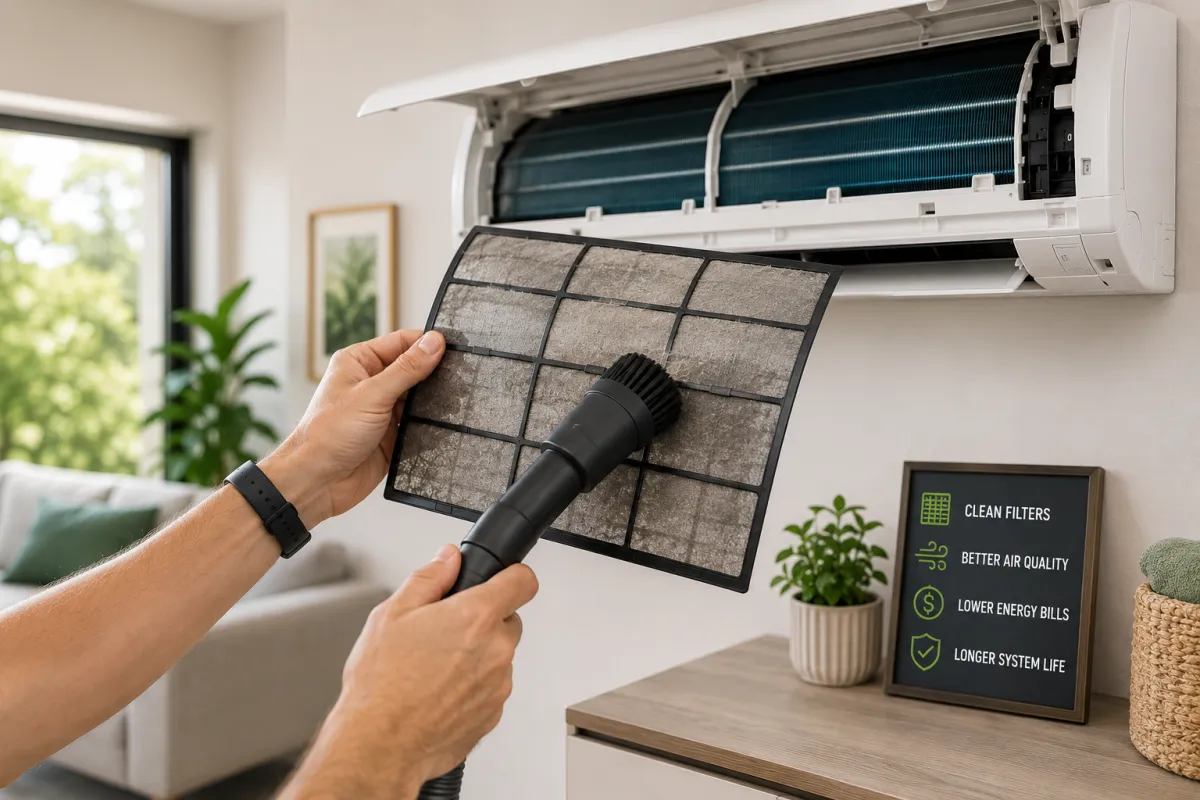
How to Clean Your Air Conditioner Filters
How to Clean Your Air Conditioner Filters (And Why a Deep Clean Does More Than You Think)
Most people know they're supposed to clean their air conditioner filters. Not as many people actually do it. And even fewer realise that wiping the filters is just the start, the rest of the unit needs attention too, and when it doesn't get it, you start to notice.
Here's a practical guide to filter cleaning, why it matters more than most people think, and when it's time to call in a professional for a proper deep clean.
Why Clean Filters Matter
Your air conditioner pulls air from the room, passes it over the evaporator coil to cool or heat it, and blows it back out. The filter sits in front of that coil to catch dust, pet hair, pollen and everything else floating around in your home.
When the filter gets clogged, a few things happen, none of them good:
Airflow drops. The unit has to work harder to push air through, which increases power consumption.
Cooling or heating performance suffers. You'll notice rooms taking longer to reach temperature, or the unit struggling on hot days.
The coil can ice up. Restricted airflow can cause the evaporator coil to freeze, which means the unit stops working properly until it thaws out.
Air quality drops. A dirty filter stops doing its job and can start circulating dust back into the room.
Basically, a blocked filter is one of the most common reasons we get called out for air conditioning that "isn't working properly" — and half the time, it's a fixable issue that could have been prevented.
How to Clean Your Filters (DIY)
For most split systems, this is a straightforward job you can do yourself every three to four weeks during heavy use.
What you'll need: A soft brush or vacuum with a brush attachment, lukewarm water, a dry cloth.
Steps:
Turn the unit off at the remote or wall controller — don't just put it on standby.
Open the front panel. On most wall-mounted split systems, the front panel lifts up or unclips. Check your manual if you're unsure.
Remove the filters. They usually slide or clip out easily. Handle them carefully — they can be fragile when clogged.
Vacuum off the loose dust first. A soft brush attachment works well here. Do this before getting them wet.
Rinse with lukewarm water. Gentle water pressure is fine. Don't use hot water or harsh cleaning products — they can warp or damage the filter material.
Let them dry completely before putting them back in. Never reinstall wet filters.
Wipe the inside of the panel with a dry cloth while you're in there.
Replace the filters and close the panel.
That's it. Ten minutes, every few weeks during summer and winter when the unit is running regularly.
So What's a Deep Clean, and Why Does It Matter?
Here's the part that most people don't realise: the filter only catches what it catches. Over time, dust, mould spores, bacteria and grime build up on the evaporator coil, the fan blower wheel, and inside the drain pan — areas you can't reach with a damp cloth.
This is what a professional air conditioning deep clean addresses.
What's included in a proper deep clean:
Evaporator coil cleaning. The coil is the component that actually does the cooling. A layer of grime on the coil acts as insulation and significantly reduces efficiency — the unit has to run longer to achieve the same result.
Blower wheel and fan cleaning. The fan blower wheel (sometimes called a scroll fan) is notorious for accumulating a thick coating of dust, mould and debris. This restricts airflow, creates noise, and can make the air coming out smell musty. This is almost always the cause of that "dirty sock" smell people notice from older units.
Drain pan and drain line. Condensate (water) drains from the unit via a pan and drain pipe. If these get blocked or mouldy, water can overflow and cause damage to your ceiling or walls. A deep clean clears this out.
Anti-bacterial treatment. A quality service will include treatment to kill mould and bacteria inside the unit, which directly improves the air quality being circulated in your home.
Signs you're due for a deep clean:
The air coming out smells musty, stale or like mildew
The unit is taking longer than usual to cool or heat the room
You notice reduced airflow even with clean filters
It's been more than 12 months since the unit was professionally serviced
You've moved into a home and don't know the history of the unit
How Often Should You Get a Deep Clean?
As a general guide, once a year is a good rhythm for most households. If you have pets, smokers in the house, or you're running the unit almost year-round (which is pretty normal in Greater Springfield), every 6 to 12 months makes sense.
A lot of homeowners find that after a professional deep clean, their unit is noticeably quieter, cools faster and costs less to run. It's one of those things where the difference is immediately obvious.
DIY Cleaning vs Professional Service
Regular filter cleaning is absolutely something you can and should do yourself, it's simple, quick and makes a real difference to day-to-day performance.
But when it comes to the coil, blower wheel and drain components, it's a professional job. Getting into those areas without the right tools or knowledge can damage the unit, void your warranty, and in some cases create a safety issue.
If your unit is due for a proper service, or it's been years since anyone looked at it, that's something we can help with.
Book a service with GreNRG and we'll get your system running the way it should.
GreNRG Electrical Solutions provides air conditioning installation and servicing for homeowners in Greater Springfield, Ipswich and Brisbane West. We're straight-talkers who'd rather you maintain your system properly than call us out for an avoidable problem.
